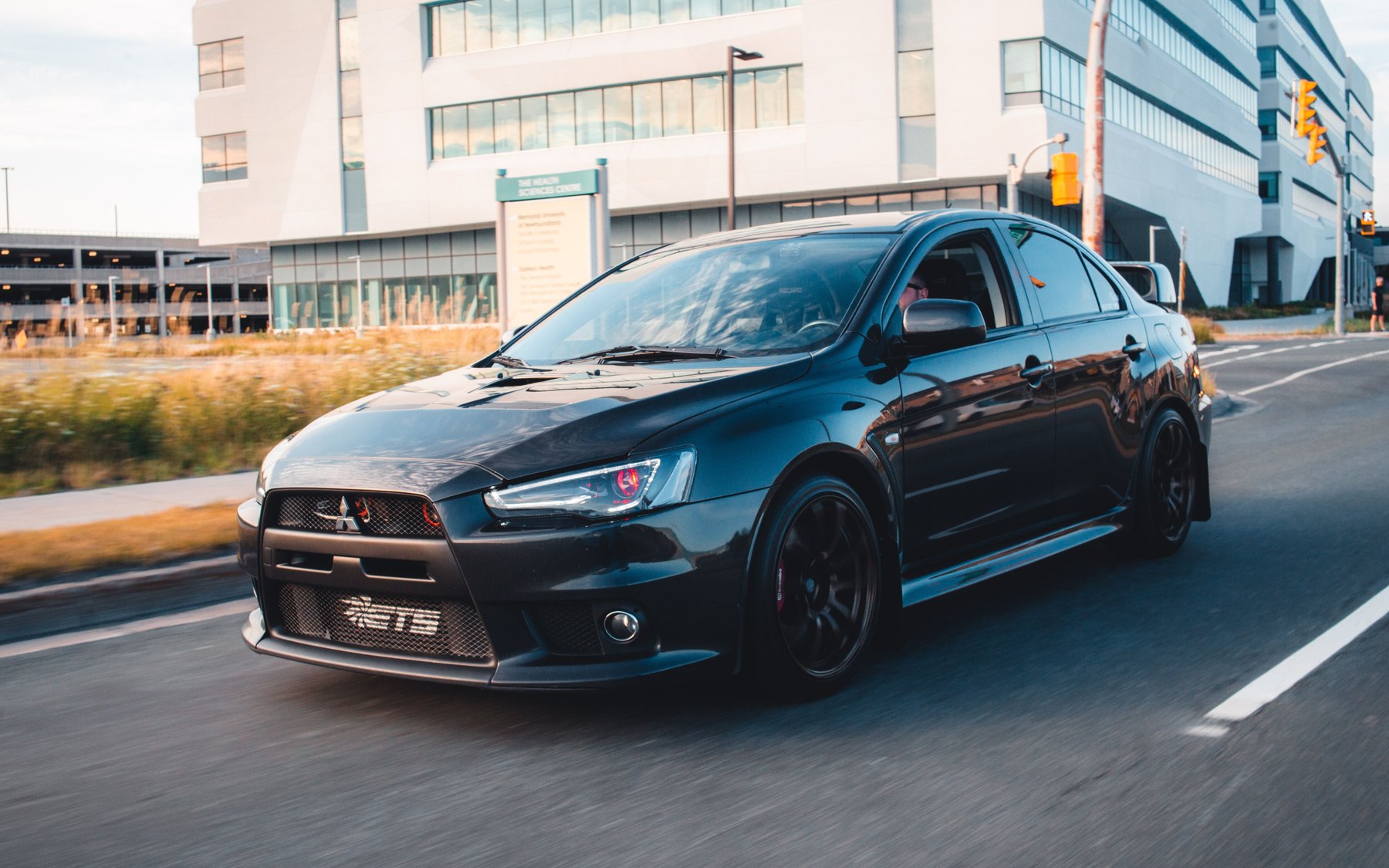
Power by stage
Stock is Mitsubishi's US figure at the engine. Stage 1 is COBB's peak gain in percent; Stage 2 to 4 are shops' and makers' figures at the wheels, so they read lower than engine power. US 93 octane equals 98 RON, the best fuel sold in Israel.
Names with an arrow go straight to that part's product page for this car.
Stage 1: Software only
+13%COBB's Stage 1 map for the Evo X on 93 octane adds a peak of 13% power and 10% torque, and up to 14% torque at some engine speeds (COBB map notes). On the MR, the Accessport also logs the TC-SST gearbox (STM), which matters because the twin-clutch box is the first thing to watch as torque rises.
Typical cost: COBB Accessport V3 $560 (STM) or the Stage 1 Power Package with a high-flow filter $585 (Patterson Performance Parts).List prices, Sept 2026, before shipping, import tax and fitting.
Stage 1 tunes compared
| Tune | Fuel | Peak power gain | Peak torque gain | Notes |
|---|---|---|---|---|
| COBB Accessport Stage 1 | 93 octane (98 RON) | +13% | +10% (up to +14%) | Off-the-shelf map, stock car; $560 (STM) |
| COBB Stage 1 Power Package | — | — | — | Accessport V3 with a high-flow filter; $585 |
Parts list
- Engine tune required
COBB Accessport V3EcuTek Evo X support
The Accessport flashes through the OBD port and stores off-the-shelf or custom maps.
- Air filter optional
COBB high-flow filterK&N Evo X drop-in filter
COBB's Stage 1 package adds a drop-in filter for the stock airbox.
Stage 2: Intake, intercooler, downpipe and fuel
310–390 whpStage 2 is where the Evo X wakes up. COBB's NexGen Stage 2 package adds an intake and airbox, hard pipes, a front-mount intercooler and a 3-inch downpipe (COBB), and EDO Performance says its own Stage 2 kit makes up to 310 whp on a Dynapack on 91 octane (EDO Performance). With a bigger fuel pump and injectors on the stock turbo and engine, Optimized Performance tuned a 2008 Evo X to 387 whp and 361 lb-ft at the wheels on 91 octane, and 408 whp on E85 (Optimized Performance).
Typical cost: COBB NexGen Stage 2 package $2,595 (COBB), EDO Performance Stage 2 kit $2,396 or an ETS intercooler $759.List prices, Sept 2026, before shipping, import tax and fitting.
Stage 2 results compared
| Setup | Fuel | Claimed or measured power | Price | Hardware |
|---|---|---|---|---|
| EDO Performance Stage 2 | 91 octane (95 RON) | up to 310 whp | $2,396 | Intake, downpipe, test pipe, cat-back, intercooler pipes |
| Optimized Performance 2008 Evo X | 91 octane (95 RON) | 387 whp | — | 361 lb-ft; stock turbo and block, Walbro 255 pump, ID1000 injectors |
| COBB NexGen Stage 2 | — | — | $2,595 | Accessport, intake and airbox, hard pipes, front-mount intercooler, 3-inch downpipe |
Parts list
- Intercooler recommended
ETS intercoolerAMS Evo X front-mount intercooler
ETS claims +10 to +22 whp over stock, depending on the core; $759.
- Downpipe recommended
COBB 3-inch downpipeETS Evo X downpipeAMS Widemouth downpipe
Part of COBB's NexGen Stage 2 package.
- Fuel system optional
Injector Dynamics ID1050-XDS
The 387 whp car has a Walbro 255 pump and ID1000 injectors.
Stage 3: Bigger turbo on the stock block
420–475 whpThe next step is a bigger turbo. Optimized Performance tuned a 2011 Evo X MR with a MAP EF4 turbo, the stock engine and the stock TC-SST gearbox to 418 whp and 379 lb-ft at the wheels on 93 octane (Optimized Performance). Forced Performance rates its stock-location Green turbo for the Evo X at more than 475 whp (Forced Performance) and its ball-bearing Red at more than 525 whp (MAPerformance). STM warns that the stock rods and the MR's clutch packs are the limits here (STM).
Typical cost: Forced Performance Green turbo $2,249, Red ball-bearing $3,249 (MAPerformance) or the ETS turbo kit $5,545.List prices, Sept 2026, before shipping, import tax and fitting.
Turbo builds compared
| Build | Fuel | Claimed or measured power | Price | Notes |
|---|---|---|---|---|
| MAP EF4, stock engine and TC-SST | 93 octane (98 RON) | 418 whp | — | 379 lb-ft; AEM pump, FIC 1650 injectors |
| Forced Performance Green | — | more than 475 whp | $2,249 | Stock-location journal-bearing turbo |
| Forced Performance Red (ball bearing) | — | more than 525 whp | $3,249 | Stock-location ball-bearing turbo |
Parts list
- Upgraded turbo required
Forced Performance GreenForced Performance Red
A stock-location turbo keeps the factory manifold and downpipe.
- Fuel system required
Injector Dynamics ID1050-XDSFIC 1650cc Evo X injectors
A bigger pump and injectors; the 418 whp car has 1650 cc injectors.
- Clutch recommended
ACT HD 6-puck clutch kitExedy Stage 1 clutch kit
On the GSR, ask the shop whether the stock clutch will hold this torque.
Stage 4: Built short block and big turbo
up to 806 whpPast roughly 600 whp, the 4B11T needs a built short block with forged pistons and rods, and STM says the biggest builds also need sleeves and E85 (STM). MAP's Stage 2 built short block uses Wiseco forged pistons, Manley rods, ARP main studs and dry sleeves (MAPerformance). ETS sells a T4 twin-scroll turbo kit and shows an Evo X with a Precision 6765 at 806 whp, from the same kit it used for what it calls the only Evo X in the 9s (ETS). Forced Performance rates its Black turbo at more than 575 whp (Forced Performance).
Typical cost: MAP Stage 2 built short block $9,749 and the ETS T4 twin-scroll turbo kit $6,324.List prices, Sept 2026, before shipping, import tax and fitting.
Big-turbo builds compared
| Build | Fuel | Claimed or measured power | Price | Notes |
|---|---|---|---|---|
| ETS T4 twin-scroll kit + Precision 6765 | — | 806 whp | $6,324 | ETS doesn't list the engine build or fuel |
| Forced Performance Black | — | more than 575 whp | $2,349 | Stock-location journal-bearing turbo |
| MAP Stage 2 built short block | — | — | $9,749 | Wiseco pistons, Manley rods, ARP studs, dry sleeves |
Parts list
- Built short block required
MAP Stage 2 short blockManley 4B11T rod setWiseco 4B11T piston set
Forged pistons and rods, and sleeves for the biggest builds.
- Big turbo kit required
ETS T4 twin-scroll kitETS turbo kit
ETS's kits come with two TiAL wastegates; the standard kit is $5,545.
- Fuel and gearbox required
Injector Dynamics ID1300-XDS
A fuel system sized for E85, and a clutch or TC-SST work to match the torque.
Quick answers
- How much horsepower does a stock Mitsubishi Lancer Evolution X have?
- 291 hp from the factory.
- How much hp does a Stage 1 Mitsubishi Lancer Evolution X make?
- Tuners claim +13% hp at Stage 1, up from 291 hp stock (Stage 1 options).
- How much hp does a Stage 2 Mitsubishi Lancer Evolution X make?
- Tuners claim 310–390 whp with a Stage 2 file and the parts it needs (parts list).
- How much hp does a Stage 3 Mitsubishi Lancer Evolution X make?
- Tuners claim 420–475 whp at Stage 3: bigger turbo on the stock block (Stage 3 parts).
- How much hp does a Stage 4 Mitsubishi Lancer Evolution X make?
- Stage 4 is the top of the ladder for this car: built short block and big turbo. The biggest builds claim 806 whp. Check which fuel each figure needs: Israel sells 95 and 98 octane only (Stage 4).
- How much does a Stage 1 Mitsubishi Lancer Evolution X cost?
- List prices: COBB Accessport V3 $560 (STM) or the Stage 1 Power Package with a high-flow filter $585 (Patterson Performance Parts).
What we'd do
Stage 2 on the stock turbo is the sweet spot on an Evo X, and it works on 95. EDO Performance says its Stage 2 kit, with intake, downpipe, test pipe, cat-back and intercooler pipes, makes up to 310 whp on 91 octane, roughly our 95. With a bigger pump and injectors Optimized Performance tuned a 2008 car to 387 whp on the same fuel, on the stock turbo and engine.
Check the software first. COBB's off-the-shelf maps are for US 2008–2015 GSR and MR cars only; for other markets COBB lists stock maps only, so a car brought in from elsewhere needs a custom tune. EcuTek also supports the Evo X, and each has a dealer here. COBB also requires an upgraded fuel pump relay with all its calibrations.
Buy in this order: tune and logs, then the intercooler (ETS's is $759 and claims +10 to +22 whp), then the downpipe with a high-flow catalyst, then fuel. COBB's NexGen Stage 2 package bundles the Accessport, intake, hard pipes, front-mount intercooler and a 3-inch downpipe for $2,595; EDO's kit is $2,396 but comes with a test pipe. Skip the test pipe: it has no catalyst and won't pass the test here. Skip the 408 whp figure too: it needs E85.
The weak points are the drivetrain and the rods. On the MR, STM says the TC-SST's stock clutch packs tend to slip around 350 lb-ft of torque, and that the stock rods are the known failure point once torque climbs past about 400 lb-ft. On the GSR the clutch is the question. A MAP EF4 turbo took an MR with the stock engine and gearbox to 418 whp, but that is the edge, not a daily setup.
Tuning it in Israel
- Parts from abroad
At the Bank of Israel representative rate of 26 October 2026 ($1 = ₪3.078), the COBB Accessport V3 ($560) is ₪1,724 and the ETS intercooler ($759) ₪2,336. Above $75 both carry 18% VAT plus purchase tax, about 40.66% combined on car parts and car electronics (our import guide): ₪1,724 × 1.4066 = about ₪2,425 for the Accessport and ₪2,336 × 1.4066 = about ₪3,286 for the intercooler. COBB's NexGen Stage 2 package ($2,595) lands at about ₪11,235. All before shipping, which is taxed too. Downpipes and other exhaust parts also need an approval before they can be imported.
- Fuel
COBB names each Evo X map after its minimum fuel: "91" maps are for 95 RON and "93" maps for 98 RON, and it says never to run a map written for higher octane on lower octane fuel. Its Stage 1 figures were measured on 93, our 98. The Stage 2 results in this guide from EDO (310 whp) and Optimized Performance (387 whp) are on 91, roughly our 95, so 95 is a workable fuel for this car if the file is written for it (95 vs 98 after a tune). The 408 whp result needs E85, which Israeli stations don't sell.
- Regulation 380 and the test
The Road Safety Authority reads Regulation 380 as covering engine software, so record the tune like any other change (how approval works). The Ministry's list names a special exhaust outright: on this build the downpipe, the pipe that replaces the catalyst and the cat-back need a part with a lab prototype certificate, fitted by a licensed installer and recorded in the licence. A test pipe has no catalyst, and passing the annual test doesn't make an unapproved change legal. A bigger turbo and a front-mount intercooler are changes too. Fixed noise fines are ₪250, or ₪350 for driving without an effective silencer.
- Where to get it done
COBB's dealer list names PIT-STOP and Palracing in Holon, SecretTuning in Petah Tikva and CH Performance in Peki'in. EcuTek's tuner list names Top RPM in Holon. These are the brands' own lists, checked October 2026; we have no link with any of them.
Prices and rules checked 2026-11-10.
Also useful: tuning shops in Israel, the import tax calculator and the annual test checklist.
What owners ask
- COBB Stage 1, or a custom tune from a tuner?
In a 2018 thread a new owner of a stock Evo asked about the COBB Stage 1. Replies said it is nice if you stay stock, but if you plan parts, get a custom tune from a reputable tuner, either through the Accessport or open-source tools. One owner liked the Accessport for its screen and logging. Another warned that with the Accessport you can't switch off one emissions system and will see check-engine lights past 500 whp. For a stock car we would take Stage 1; for Stage 2, a custom tune.
Sources: EvoXForums: Cobb Stage 1 (2018), COBB: Map notes for Evo X
- How much torque will the MR's twin-clutch gearbox take?
A 2011 thread is the usual answer. One owner quoted Getrag's official figure of 470 Nm, about 347 lb-ft; MR owners put the practical limit at about 350 lb-ft at the wheels on a Dynojet, and recommended upgraded clutch packs to go further. One owner ran about 450 whp and 400 lb-ft on the stock clutches for 2,000–3,000 miles before his engine failed. Others asked which dyno the limit applies to. STM's guide gives the same ceiling: the stock packs tend to slip around 350 lb-ft.
Sources: EvoXForums: MR SST WHP Tranny Limit (2011), STM: Evo X turbo kit power goals guide
- How much power will the stock 4B11T engine hold?
Owners in a long thread from 2010 agreed that torque, not horsepower, breaks the engine. Suggested limits were about 400 lb-ft at the wheels and around 30 psi of boost, and one owner said rods fail beyond 420 lb-ft. A 2020 reply added that torque is set mostly by the tune, quoting 550 whp at 376 lb-ft on a big turbo. STM's guide puts the stock-block sweet spot at about 400 whp, with the rods as the documented failure point past roughly 400 lb-ft. Past that, see Stage 4.
Sources: EvoXForums: How much power will the stock 4b11T hold? (2010), STM: Evo X turbo kit power goals guide
- Will the GSR's stock clutch hold a tuned car?
Opinions in a 2014 thread run both ways. One owner said the stock clutch is one of the weakest parts on the car once you add a few mods. Others reported it holding for tens of thousands of miles: one GSR at 350 whp and 350 lb-ft through hundreds of dyno pulls, another at 430 whp on track. The common thread was launches: owners who launched the car often wore it out, and one blamed early failures on driver error. If you plan launches, budget for a clutch with the tune.
Sources: EvoXForums: 350+whp for over 50k miles, still on stock clutch (2014)
- Is there a downpipe with a catalyst for the Evo X?
An owner asked in 2013 about a catless downpipe after hearing a loud car. Replies explained that no Evo X downpipe has a catalyst: on this car the catalyst sits in a separate pipe after the downpipe, so the choice is between a high-flow catalyst and a test pipe with none. The test pipe is much louder, and a resonated one is a middle option. Owners also pointed out that the cat-back decides most of the noise. Here a test pipe fails the annual test, so we would keep a high-flow catalyst.
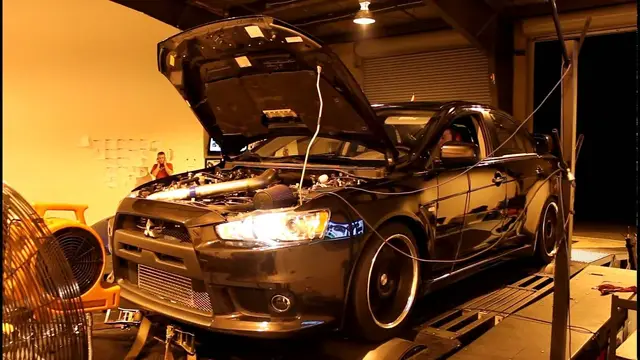
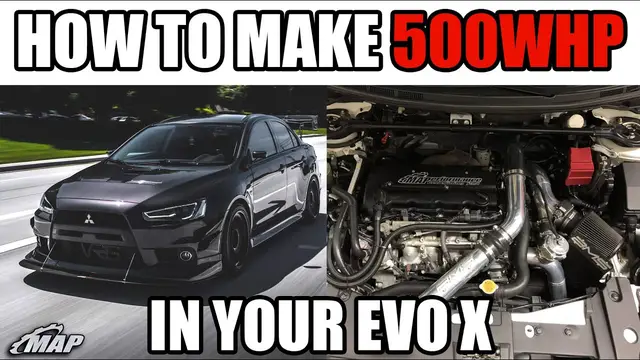
Watch: real builds
From tuners', shops' and motoring journalists' own YouTube channels. Nothing loads from YouTube until you press play.
New guides by email
One short email when a new car guide goes live. No spam, unsubscribe any time. We'll send a confirmation link first (by Brevo); see our privacy policy.
Questions to ask the shop
- Is my car a GSR with the 5-speed manual or an MR with the TC-SST, and what torque will my gearbox take?
- Will you log knock before and after the tune, and is the file written for 98 octane?
- At what power do you require forged rods and pistons on the 4B11T?
- Do you tune the TC-SST's clutch pressures as well as the engine?
- At what torque do you insist on an uprated clutch on the GSR?
- Does the setup keep a catalyst, so the car passes inspection?
Which car should we cover next?
One new guide every week. Tap “Me too” on a car you want, or search for any car on our list. The most-requested cars get written first.